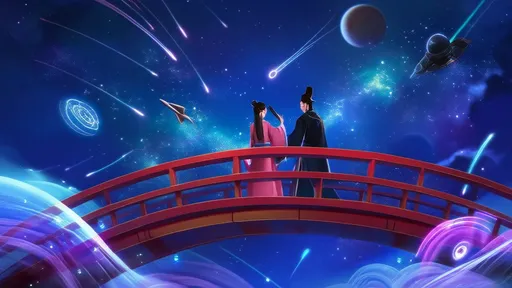
The Qixi Festival, often called Chinese Valentine's Day, has been celebrated for over two millennia. Rooted in the poignant legend of the Cowherd and Weaver Girl, this festival traditionally symbolizes the annual reunion of two star-crossed lovers across the Milky Way, facilitated by a bridge formed by sympathetic magpies. Yet, as we navigate the digital age, the essence of this ancient tale is being reinterpreted through the lens of modern technology.
The enduring legend speaks of Zhinü, the Weaver Girl, and Niulang, the Cowherd, whose love was so profound that it moved the magpies to create a bridge each year on the seventh day of the seventh lunar month. This celestial rendezvous became a metaphor for love that transcends physical separation. For centuries, the story has inspired poets, artists, and lovers alike, serving as a cultural touchstone for romantic devotion.
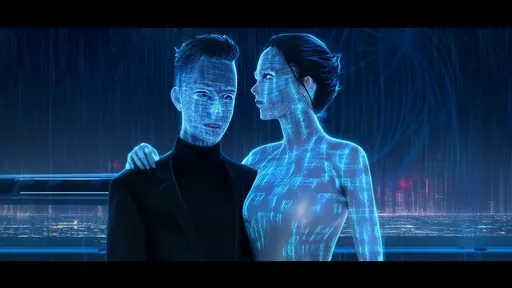
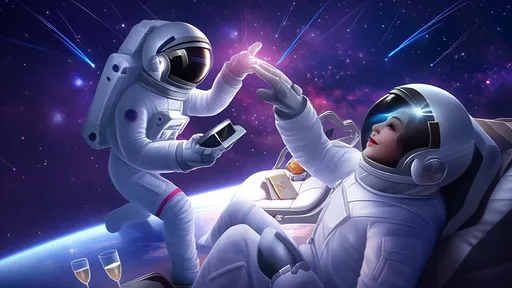
Fast forward to the 21st century, and the magpie bridge has taken on new forms. Satellite communication technology now enables real-time conversations across continents, making the concept of waiting a whole year for a single meeting seem archaic. Couples separated by oceans can share moments instantly through video calls, bridging distances that would have been unimaginable to the ancient Chinese storytellers who first imagined the celestial lovers.
The evolution from myth to technology reflects more than just scientific progress; it represents a shift in how we conceptualize connection. Where once the magpie bridge symbolized the miraculous, today's satellite networks make constant connection mundane. This transformation raises fascinating questions about the nature of romance in an era when absence is no longer enforced by geography but often chosen amidst the noise of constant availability.
Cultural preservation meets innovation as young Chinese couples find ways to honor tradition while embracing modern conveniences. Some send digital red envelopes via messaging apps instead of traditional gifts, while others plan virtual dates that span time zones. The fundamental human desire for connection remains unchanged, but the methods have evolved beyond what the original legend could have envisioned.
Interestingly, China's technological advancements have created a poetic parallel to the ancient myth. The country's BeiDou satellite navigation system, now a global competitor to GPS, literally connects people across space - much like the celestial bridge of legend. This synergy between cultural heritage and cutting-edge technology offers a uniquely Chinese perspective on how ancient stories can find new relevance.
The environmental angle presents another layer of reinterpretation. Conservationists have noted the declining populations of magpies in some urban areas, making the traditional imagery increasingly symbolic. In contrast, the "bridges" we build today through technology leave no ecological footprint, offering an unexpected advantage to modern interpretations of the festival.
As we celebrate Qixi in the digital age, the festival becomes less about lamenting separation and more about celebrating the myriad ways love can flourish despite physical distance. The magpies may still hold symbolic value, but their role as literal connectors has been supplanted by satellites orbiting the Earth, transmitting countless love messages every second.
This evolution from avian bridges to digital connections doesn't diminish the romance of Qixi; rather, it demonstrates how cultural traditions can adapt while retaining their emotional core. The longing expressed in ancient poems about the Cowherd and Weaver Girl finds its contemporary equivalent in the bittersweet goodbyes at airport security or the glowing smartphone screens that light up dark bedrooms during late-night video calls.
Looking forward, the Qixi Festival may continue to transform as technology advances. Virtual reality could create shared digital spaces for couples, while advances in translation technology might make cross-cultural relationships even more seamless. Yet regardless of the medium, the essential message remains: love finds a way to bridge any divide, whether celestial, terrestrial, or digital.
The story that began with magpies forming a temporary bridge across the stars now continues with signals bouncing between satellites. Both versions speak to humanity's enduring need to connect, proving that while our tools change, our hearts' desires remain remarkably constant across the centuries.

By /Jul 3, 2025

By /Jul 3, 2025
By /Jul 3, 2025

By /Jul 3, 2025

By /Jul 3, 2025

By /Jul 3, 2025
By /Jul 3, 2025

By /Jul 3, 2025

By /Jul 3, 2025
By /Jul 3, 2025

By /Jul 3, 2025
By /Jul 3, 2025

By /Jul 3, 2025

By /Jul 3, 2025

By /Jul 3, 2025

By /Jul 3, 2025

By /Jul 3, 2025

By /Jul 3, 2025