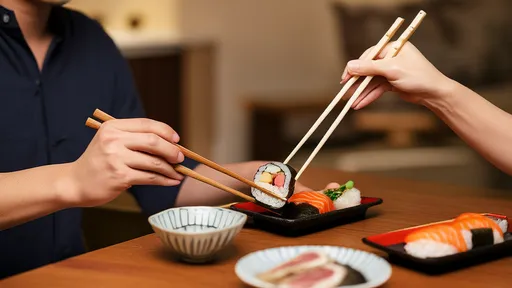
In the dim glow of a Shanghai jazz bar, Mei's chopsticks hovered over a plate of xiaolongbao as she watched David struggle with the delicate soup dumplings. His fork punctured the thin skin, sending precious broth spilling across the bamboo steamer. That moment - equal parts comical and revealing - became their private metaphor for the beautiful clumsiness of intercultural love.
The Cutlery Chronicles
What we eat with matters more than we think. For couples bridging Eastern and Western cultures, the humble utensils on their dinner tables tell silent stories of adaptation. The French anthropologist Claude Lévi-Strauss once observed that food is good to think with before it's good to eat. Tableware, it turns out, makes for equally nourishing philosophy.
Western cutlery evolved as specialized tools - steak knives for conquest, fish forks for precision, butter spreaders for ceremony. The fork's tines embody the analytical tradition, dividing to conquer. Meanwhile, the Chinese chopstick represents unity - two equal partners working in harmony to lift, not pierce. One culture separates, the other connects. Both get fed.
When Toronto-born David first met Mei's parents, the ceremonial tea nearly became a diplomatic incident. "I kept reaching for the cup with one hand," he recalls. "Mei later explained that receiving tea properly requires both hands - it's about showing complete presence." Such moments reveal how even our smallest gestures carry cultural DNA.
The Language of Leftovers
Food waste became an unexpected battleground for Sofia and Hiro. In her Italian household, scraping your plate clean signaled satisfaction. For Hiro's Japanese family, leaving a bite showed the host had provided abundantly. "Our first fight was over a uneaten ravioli," Sofia laughs. "I thought he disliked my cooking. He thought he was being polite."
These culinary mistranslations extend beyond the dinner table. The German preference for direct communication often collides with the Thai "kreng jai" (avoiding discomfort). Brazilian spontaneity can overwhelm Swiss planning. As relationship counselor Dr. Amina Khalid observes: "We don't just marry a person - we marry their culture's entire approach to time, space, and human connection."
Third-Culture Love
The most successful intercultural couples often become architects of their own traditions. Take Lena and Rajiv's "Chai-misu" - a layered dessert merging Italian tiramisu with Indian masala chai. Or Mark and Yuki's bilingual parenting approach where their daughter learns Japanese honorifics alongside American slang.
Psychologists note that these hybrid relationships require what they call "cultural code-switching" - the ability to navigate different social operating systems. It's exhausting but expansive work. As Lena puts it: "Some days I feel like a full-time translator between my husband and the rest of America. Other days, I realize he's doing the same for me with India."
The rewards? A rare kind of emotional bilingualism. Children of such unions often develop what researchers call "cognitive flexibility" - enhanced problem-solving skills from constantly navigating cultural ambiguity. They become natural mediators, seeing multiple perspectives before breakfast.
The Unseen Baggage
Not all challenges are so delicious. Unspoken assumptions about gender roles surface in surprising ways. German engineer Anika was shocked when her Egyptian fiancé insisted on carrying her luggage. "I saw it as him questioning my capability. He saw it as basic chivalry." These moments reveal invisible cultural scripts about masculinity and independence.
Financial philosophies also collide. The Scandinavian habit of splitting bills atomically conflicts with many Asian and Latin American traditions of reciprocal generosity. "My Swedish boyfriend actually Venmo requested me for half a coffee," laughs Mexican artist Carmen. "In my family, that's like charging someone for air."
Then there are the holidays. American Thanksgiving meets Mid-Autumn Festival. Do you bow or hug in-laws? Which grandparents get first dibs on Christmas versus Lunar New Year? The calendar becomes a minefield of competing loyalties.
When Chopsticks Learn to Fork
The magic happens in the adaptation. Take James, who mastered the art of Chinese banquet toasting to impress his wife's relatives. Or Priya, who surprised her Dutch husband by learning to ice skate for his family's Christmas tradition. "I fell constantly," she admits. "But they loved that I tried."
Successful couples develop what anthropologists call "cultural intelligence" - the ability to read between cultures. They create safe words for when translations fail. They become experts in the grammar of each other's silences. Most importantly, they learn to laugh at their own cultural blind spots.
Perhaps this is why intercultural marriages report higher creativity levels in conflict resolution. When you can't rely on shared assumptions, you invent new solutions. You become culinary alchemists, turning cultural differences into relational gold.
Back in Shanghai, David now uses chopsticks with fluid grace, while Mei has developed a surprising taste for blue cheese. Their kitchen boasts a wok alongside a pasta maker. Some nights they eat burgers with chopsticks just because they can. After all, love at its best doesn't choose between chopsticks and forks - it revels in having both at the table.

By /Jul 3, 2025

By /Jul 3, 2025

By /Jul 3, 2025
By /Jul 3, 2025

By /Jul 3, 2025

By /Jul 3, 2025

By /Jul 3, 2025

By /Jul 3, 2025

By /Jul 3, 2025

By /Jul 3, 2025

By /Jul 3, 2025

By /Jul 3, 2025

By /Jul 3, 2025

By /Jul 3, 2025
By /Jul 3, 2025

By /Jul 3, 2025
By /Jul 3, 2025

By /Jul 3, 2025