Under the Mistletoe: A Cultural Archaeology of Forced Kissing

Jul 3, 2025 By

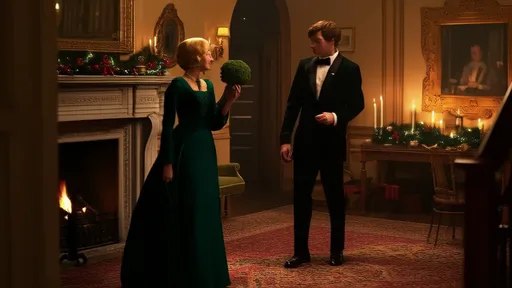
The tradition of kissing under the mistletoe is one of the most enduring and whimsical customs associated with Christmas. What appears as a lighthearted festive practice, however, carries with it a complex history that intertwines mythology, folklore, and social rituals. The mistletoe’s journey from sacred plant to a symbol of forced affection reveals much about how traditions evolve, often obscuring their darker origins beneath layers of merriment.

The Sacred Roots of Mistletoe

Long before it became a fixture of Christmas decor, mistletoe held profound significance in ancient cultures. The Druids revered it as a magical plant, believing it possessed healing properties and the power to ward off evil spirits. Its ability to thrive in winter, growing as a parasitic plant on oak trees, made it a symbol of resilience and fertility. Norse mythology further elevated its status—the story of Baldur, killed by a mistletoe arrow and later resurrected, cemented its association with both death and rebirth. These early beliefs laid the groundwork for the plant’s later romantic connotations, though its connection to kissing was still centuries away.

By the Middle Ages, mistletoe had become entangled in European folk traditions, often linked to luck and protection. It was hung in homes to prevent fires or to ensure a fruitful harvest. Yet, somewhere along the way, the plant’s symbolism shifted toward romance. Some historians trace this transition to the Celtic belief that mistletoe promoted fertility, while others point to its role in medieval courtship rituals, where it was used as a charm to encourage marriage proposals. The exact moment when kissing entered the picture remains unclear, but by the 18th century, the custom had taken root in England.

The Rise of the "Kissing Bough"

The Victorians, with their fondness for codifying social rituals, transformed the mistletoe into a tool for enforcing flirtation. The "kissing bough," a decorative orb woven from mistletoe and other evergreens, became a centerpiece of Christmas festivities. Rules emerged: a woman standing beneath the mistletoe could not refuse a kiss, lest she face bad luck or spinsterhood. Refusal was socially unacceptable, and the act was framed as harmless fun—yet it was anything but voluntary. This practice, though dressed in the veneer of holiday cheer, reflected the era’s rigid gender norms, where women had little agency to decline advances without consequence.

Literature and art of the period reinforced the custom. Charles Dickens, in his 1836 sketch "Christmas Festivities," described the mistletoe as "the young men’s privilege." Illustrations from Victorian Christmas cards often depicted men seizing women under the plant, portraying the act as playful rather than coercive. The framing was deliberate: by making the ritual seem innocuous, it normalized the idea that consent could be bypassed under the guise of tradition. The mistletoe, once a sacred symbol, had become a socially sanctioned means of pressuring women into unwanted intimacy.

Modern Reckonings and Reinterpretations

Today, the mistletoe tradition persists, though its implications are increasingly scrutinized. In an era of heightened awareness around consent, the idea of obligatory kissing feels archaic, even uncomfortable. Some have abandoned the practice altogether, while others attempt to reclaim it by emphasizing mutual agreement—a kiss only if both parties are willing. The mistletoe’s evolution mirrors broader cultural shifts, where long-standing traditions are reevaluated through contemporary ethical lenses.

Yet, the mistletoe’s darker history is often overshadowed by its festive reputation. Few who hang the plant today are aware of its ties to coercion or its role in reinforcing gendered power dynamics. This disconnect highlights how easily traditions can obscure their origins, becoming detached from the contexts that shaped them. The mistletoe’s journey—from sacred herb to romantic prop to a subject of critique—serves as a reminder that even the most seemingly benign customs carry hidden narratives.

A Symbol in Flux

What, then, is the future of the mistletoe kiss? As society grapples with the legacies of outdated rituals, the tradition may continue to adapt or fade altogether. Some argue for its preservation as a quaint relic, stripped of its coercive undertones. Others see it as a relic best left in the past. Regardless of its fate, the mistletoe’s story offers a lens through which to examine how cultural practices are constructed, perpetuated, and, when necessary, challenged.

The next time you encounter a sprig of mistletoe, consider the weight of its history. Behind the festive greenery lies a tale of mythology, social control, and the slow, ongoing struggle to reconcile tradition with progress. Whether it remains a holiday staple or becomes a footnote in cultural history, its legacy is a testament to the power of symbols—and the responsibility that comes with perpetuating them.

Recommend Posts
Romance

Bare Branches' Counterattack: 1111 Becomes the Hottest Marriage Proposal Day"

By /Jul 3, 2025

In a surprising twist of cultural evolution, China's once-obscure Singles' Day has transformed into one of the most popular dates for marriage proposals across Asia. What began as a tongue-in-cheek celebration for unattached youth has blossomed into a romantic phenomenon, with November 11th now rivaling Valentine's Day as the calendar's most significant date for declarations of love.
Romance

Under the Mistletoe: A Cultural Archaeology of Forced Kissing

By /Jul 3, 2025

The tradition of kissing under the mistletoe is one of the most enduring and whimsical customs associated with Christmas. What appears as a lighthearted festive practice, however, carries with it a complex history that intertwines mythology, folklore, and social rituals. The mistletoe’s journey from sacred plant to a symbol of forced affection reveals much about how traditions evolve, often obscuring their darker origins beneath layers of merriment.
Romance

A New Interpretation of Qixi: The Evolution from Magpie Bridge to Satellite Calls"

By /Jul 3, 2025

The Qixi Festival, often called Chinese Valentine's Day, has been celebrated for over two millennia. Rooted in the poignant legend of the Cowherd and Weaver Girl, this festival traditionally symbolizes the annual reunion of two star-crossed lovers across the Milky Way, facilitated by a bridge formed by sympathetic magpies. Yet, as we navigate the digital age, the essence of this ancient tale is being reinterpreted through the lens of modern technology.
Romance

A Valentine's Day Survival Guide: Anti-Consumerist Romantic Ideas"

By /Jul 3, 2025

Valentine’s Day has long been synonymous with grand gestures, expensive gifts, and lavish dinners. The pressure to conform to commercialized ideals of romance can turn what should be a celebration of love into a stressful, wallet-draining affair. But what if we reimagined Valentine’s Day as something more authentic, less about consumerism and more about connection? This is the heart of the Valentine’s Survival Guide: Anti-Consumerist Romantic Solutions—a manifesto for those who believe love shouldn’t come with a price tag.
Romance

Breakup Power: Essential Emotional Survival Skills for the Modern Era"

By /Jul 3, 2025

In an era where romantic relationships are increasingly complex and fleeting, a new concept has emerged from China's relationship discourse: "Breakup Power" (分手力). This cultural phenomenon, detailed in the controversial self-help guide The Power to Break Up: Essential Emotional Survival Skill for Modern Times, has sparked intense debate about how contemporary individuals navigate love and separation in the age of disposable connections.
Romance

The Futility of Love: A Reassessment of Emotional Value in the Age of Utilitarianism"

By /Jul 3, 2025

In an era dominated by efficiency metrics and ROI calculations, love—that most irrational of human impulses—has become a subject of skepticism. The modern world, with its relentless focus on measurable outcomes, has little patience for the ambiguities of romance. A growing chorus of voices now questions whether love, particularly in its traditional romantic form, is anything more than a sentimental relic in our hyper-practical age.
Romance

Platonic Revenge: The Contemporary Revival of Spiritual Love

By /Jul 3, 2025

In an era dominated by dating apps and instant gratification, a quiet revolution is taking shape—one that challenges the very foundations of contemporary relationships. The concept of Platonic love, once relegated to philosophy classrooms, has emerged as a radical alternative to the physical and often transactional nature of modern romance. This revival isn't about rejecting intimacy but rather redefining it, creating space for emotional and intellectual connections that transcend the physical.
Romance

Single Worship: Why the Ability to Be Alone Determines the Quality of Love"

By /Jul 3, 2025

The hum of dating apps has become white noise in modern relationships, yet a quiet revolution brews beneath the surface. Across cosmopolitan cities from Berlin to Tokyo, a growing tribe of intentionally single individuals are rewriting the rules of intimacy. Their manifesto? That true connection begins not with swiping right, but with the radical act of sitting still with oneself.
Romance

The 'Anti-Romance' Movement: The Perils of Overly Sweet"

By /Jul 3, 2025

The modern world is drowning in saccharine. From social media feeds saturated with curated perfection to blockbuster films that tie every narrative with a glittering bow, our culture has become obsessed with romanticized ideals. This phenomenon, however, is far from harmless. A growing counter-movement—dubbed the "Anti-Romanticism" movement—argues that the relentless pursuit of sweetness, both in art and in life, carries hidden dangers. It distorts reality, fosters unrealistic expectations, and ultimately leaves individuals ill-equipped to handle life’s inevitable complexities.
Romance

Emotional Metaverse: Digital Twin Love Experiment"

By /Jul 3, 2025

The concept of love has always been a fluid, evolving phenomenon, shaped by cultural shifts and technological advancements. Now, with the rise of the metaverse, a new frontier is emerging—one where digital twins and artificial intelligence are redefining romantic connections. Emotional Metaverse: Digital Twin Love Experiments explores this uncharted territory, where human emotions intersect with virtual identities in ways that challenge our traditional understanding of relationships.
Romance

Genetic Matchmaking: Can Science Replace the Heart's Desire?

By /Jul 3, 2025

In a world where technology increasingly mediates human connections, the concept of using genetic compatibility to find love has moved from science fiction to reality. Companies now offer DNA-based matchmaking services, promising couples a higher chance of long-term happiness based on biological compatibility. But as algorithms and lab results infiltrate the realm of romance, a pressing question emerges: can science truly replace the elusive magic of falling in love?
Romance

A Guide to Booking a Space Honeymoon Trip

By /Jul 3, 2025

The concept of a honeymoon has evolved dramatically over the years, and for those seeking the ultimate adventure, space travel is now a tantalizing possibility. The idea of exchanging vows under the stars—literally—has shifted from science fiction to a plausible reality. With private space companies making significant strides, couples can now consider celebrating their union in zero gravity, surrounded by the infinite cosmos. The experience promises not just breathtaking views but also an unparalleled sense of intimacy and wonder.
Romance

The New Rules of Long-Distance Love in the Age of Frozen Eggs"

By /Jul 3, 2025

In an era where biological clocks are increasingly decoupled from romantic timelines, egg freezing has emerged as a quiet revolution in modern love. The procedure, once a fringe medical option for cancer patients, has been embraced by a growing demographic: women navigating the unpredictable terrain of 21st-century relationships. This technological pause button on fertility is rewriting the unspoken rules of courtship, commitment, and what it means to be "ready" for motherhood.
Romance

Love White Paper 2070: Will Humans Still Date Offline?"

By /Jul 3, 2025

In the year 2070, the concept of dating has undergone transformations that would have been unimaginable a century ago. The Love White Paper 2070 delves into the intriguing question: Do humans still engage in offline dating? As virtual realities and AI companions become increasingly sophisticated, the traditional notion of face-to-face romance seems almost antiquated. Yet, against all odds, the human desire for physical connection persists—albeit in unexpected ways.
Romance

Intercultural Marriage: The Philosophy When Chopsticks Meet Forks

By /Jul 3, 2025

In the dim glow of a Shanghai jazz bar, Mei's chopsticks hovered over a plate of xiaolongbao as she watched David struggle with the delicate soup dumplings. His fork punctured the thin skin, sending precious broth spilling across the bamboo steamer. That moment - equal parts comical and revealing - became their private metaphor for the beautiful clumsiness of intercultural love.
Romance

Asexual Manifesto: No Roses, Just Understanding"

By /Jul 3, 2025

In a world where romantic relationships are often portrayed as the ultimate goal, a growing community is challenging this narrative with quiet but firm resolve. The asexual movement, long overlooked in discussions about sexual orientation, is stepping into the light with a simple yet radical demand: understanding without expectation.
Romance

Wheelchair Roses: Dispelling Prejudices in Intimate Relationships for People with Disabilities"

By /Jul 3, 2025

In a world that often equates desirability with physical perfection, the intimate lives of people with disabilities remain shrouded in silence and misconception. Yet, a quiet revolution is unfolding as disabled individuals reclaim their narratives, challenging societal biases that have long denied them the right to love, passion, and emotional fulfillment. This movement isn’t about inspiration—it’s about visibility, autonomy, and the simple truth that disability and desire are not mutually exclusive.
Romance

Love for the Stars: An Autism Spectrum Emotional Guide"

By /Jul 3, 2025

In a world that often misunderstands neurodiversity, a groundbreaking new perspective emerges in "Stellar Hearts Can Love: A Relationship Guide for the Autism Spectrum". This revelatory work challenges societal assumptions by illuminating the rich emotional landscapes of autistic individuals, proving that the language of love transcends neurotypical norms.